

Clinker Storage: Why Large Cement Lines Choose Welded Steel Silos
Walk into any large cement plant and the biggest structures after the kiln itself are the clinker stores. Clinker storage is where a cement line catches its breath: it absorbs the difference between what the kiln produces around the clock and what the cement mill consumes, and it protects the plant’s most valuable intermediate product from moisture and contamination. Choosing the right storage structure for this duty is one of the highest-leverage decisions in the plant layout.
This guide explains why large cement lines converge on welded steel silos for clinker storage — what the structure must survive, how hot and abrasive clinker is handled, and what a properly engineered storage system includes from filling to discharge.
What Clinker Storage Must Do in a Cement Line
Clinker storage has two jobs, and both are about balance. The first is production balancing: the kiln runs continuously at high temperature and dislikes interruptions, while the cement mill follows the market — grinding campaigns, product changes, maintenance windows. A large clinker store decouples the two, so a mill stoppage does not force a kiln shutdown and a kiln upset does not starve the mill. The second job is quality protection: clinker is the raw material of cement quality itself, and the store must keep it dry, clean and unmixed with foreign material until it reaches the mill.
The material makes both jobs demanding. Clinker leaves the cooler hot, hard and highly abrasive, in a granular form that flows readily but punishes unprotected equipment. Storage that ignores these characteristics shows up quickly as worn handling machinery, dust emissions and clinker that has picked up moisture on its way to the mill.
Why Welded Steel Silos Fit Large Clinker Duty
For storage duties in the class that large cement lines actually need, the mainstream steel solution is the large welded steel silo. Welded silos are built from flat steel plates typically 6–25 mm thick, stiffened with circumferential and vertical ribs, and closed with a truss roof — or a space-frame roof where the diameter grows large or the roof must carry running conveyors. The construction method suits single-silo capacities of roughly 8,000–100,000 tons for cement, fly ash and clinker, which places the storage requirement of a typical large cement line comfortably inside proven territory.
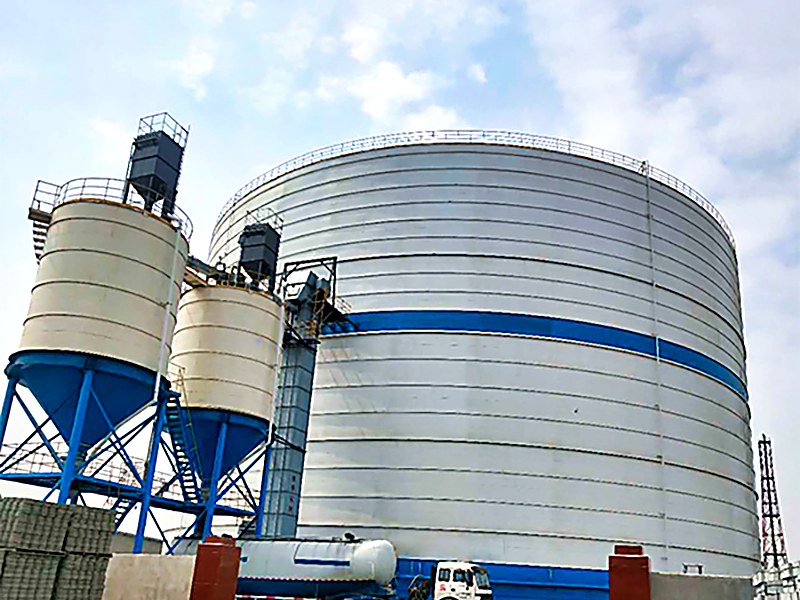
Two properties make the welded shell the right match for clinker. The first is sealing: because the shell is continuously welded, the structure is essentially airtight. That matters because clinker rehydrates when exposed to humid air — absorbed moisture degrades its reactivity and, downstream, the strength of the cement made from it. A sealed shell, topped with a roof designed to keep rain and dust out, is the cheapest insurance a cement plant can buy for clinker quality.
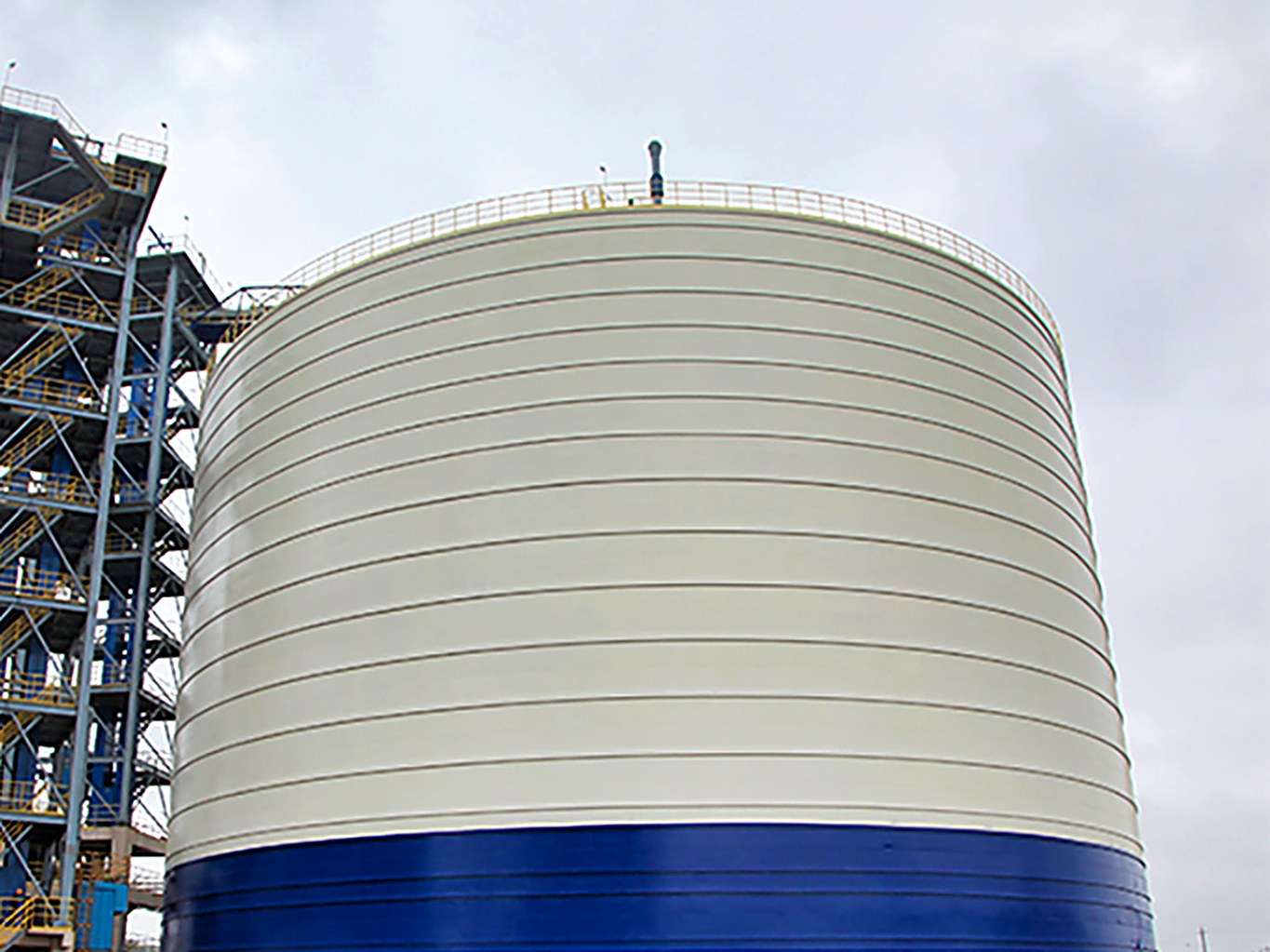
The second is structural headroom. Clinker is far heavier and more abrasive than grain-type materials, and the shell must carry decades of heavy cyclic loading. Thick flat plates with welded stiffeners give the wall the reserve to do it, and every centimeter of weld is inspectable — quality that can be verified, not assumed. For the full configuration options on this storage class, see our clinker silo page.
Construction time is the practical argument that closes the case. A large welded steel silo is erected on site in the order of four months once civil works are complete — a schedule that concrete storage structures of the same volume struggle to match — and the steel shell can be repaired, coated and re-inspected throughout a design life measured in decades.
Handling Hot and Abrasive Clinker
Everything that touches clinker wears, and the filling route feels it first. Hot clinker straight from the cooler is conveyed to the silo top on pan (apron) conveyors rather than belts: the steel pans tolerate impact from lumpy material and shrug off elevated material temperatures that would age a rubber belt prematurely. Selecting the filling conveyor for temperature and impact — not just tonnage — is one of those decisions that looks conservative on paper and pays for itself for years.
Where screw conveying is part of the clinker route, the material belongs to the most demanding conveying class: sticky-abrasive duties call for a reduced filling coefficient (roughly 0.15–0.25 versus 0.3–0.45 for free-flowing grain), and running a screw beyond its class is the fast track to worn flights and overloaded motors. For abrasive duty, screw flights are supplied hardfaced with chromium carbide or fitted with replaceable AR400/500 liner segments — sacrificial surfaces that turn an hour of downtime into a bolt change.
Discharge and Reclaim Design
Clinker flows by gravity far more willingly than fine powders, but discharge design still decides how much of the stored tonnage is actually usable. The proven concept for large clinker silos is zoned aeration discharge: aeration pads distributed across the silo floor in controlled zones, fed by Roots blowers, gently re-fluidize the material column above the discharge area so it flows reliably toward the outlet — in controlled sequence rather than as an uncontrolled rush. Zoning also lets the operator direct which part of the store is drawn down, which helps the store behave as a first-in, first-out buffer.
Geometry does the rest. Discharge cones are kept steep to promote mass flow — material moving everywhere, not just in a central channel — and tall stores combine the cone with supplemental aeration and air cannons so that compacted material cannot bridge over the outlet. The taller the silo, the more the material column compacts under its own weight, and the more the discharge design has to work with the height rather than against it.
From the discharge point, clinker moves to the cement mill feed by pan conveyor or by dedicated heavy-duty conveying, with dust collection at every transfer. As with filling, the discharge route is laid out together with the silo — bolted on later, it multiplies transfer points, dust sources and maintenance items.
Sealing, Instrumentation and Dust Control
1. Two-stage level measurement: continuous level instruments (radar or ultrasonic) track the inventory in real time, while an independent high-level detector of a different principle provides a fail-safe alarm that stops the filling conveyor before the roof is endangered.
2. Dust collection sized for peak displacement: filling a large silo displaces a large volume of air in a short time. The roof-mounted bag filter is selected for this peak displaced-air flow — not average conditions — so the vent stays clean instead of becoming a dust source.
3. Pressure protection as a pair: the filter and the pressure relief valve work together; if displaced air has no clean path out through both, over-pressure or vacuum in a sealed shell can deform the wall. The event is entirely preventable at the design stage and expensive to learn about afterwards.
4. Airtightness as a quality system: the same sealing that contains dust also keeps humid air out of the clinker mass. In coastal and high-rainfall regions this is the difference between clinker that grinds into first-grade cement and clinker that must be blended off.
What a Turnkey Clinker Storage Project Includes
A clinker storage package covers far more than the shell: foundation design matched to the soil report, the welded structure with stiffeners and roof, filling conveyors rated for temperature and impact, zoned aeration discharge with blowers and controls, dedusting at every vent and transfer, and the instrumentation that ties it into the plant control system. A recent large cement plant project combined six 10,000-ton-class welded clinker silos with four cement silos of the same construction — zoned aeration discharge, full dedusting, and sealing engineered for a high-rainfall operating environment. It is the configuration described in this guide, delivered as one contract.
That single-contract point matters. Under an EPC arrangement, one party is responsible from geotechnical review through design, fabrication, erection, commissioning and handover — one interface, one performance guarantee, and no gaps between packages where schedule and quality disputes live. Our team delivers welded steel silo projects on this turnkey basis, with customization in the 500–10,000-ton range per silo, a structural design life of typically 30 years or more, and one year of free maintenance after commissioning. For how the same storage class serves finished cement, see our cement silo page.
If you are planning clinker storage for a cement line and want filling, storage and discharge engineered as one system, contact us with your kiln capacity and site conditions — we will come back with a layout proposal and a quotation.
Frequently Asked Questions
Why choose welded steel silos for clinker instead of other types?
For cement-industry duties — cement, clinker, fly ash — the mainstream steel options are welded silos and spiral-folded silos, with large prefabricated silos considered where very large capacity or future relocation is required. Welded construction leads for large single-silo capacities because the continuous weld gives the best sealing and the thick flat plate gives the structural reserve that hot, heavy, abrasive clinker demands.
How large can a single welded clinker silo be?
The large welded silo class covers roughly 8,000–100,000 tons for cement, fly ash and clinker. Most cement lines store clinker in cells in the 10,000–50,000-ton range, sized so that the store bridges the gap between kiln output and mill consumption with the buffer days the plant’s logistics require.
How is hot clinker handled on the way into the silo?
On temperature- and impact-rated equipment: pan conveyors with steel pans carry clinker from the cooler to the silo top, and any screw-conveyed sections are sized for the abrasive class with reduced filling coefficients and hardfaced or lined flights. Equipment selection treats temperature and wear as first-order criteria, not afterthoughts.
What protects clinker quality during storage?
Three layers: an airtight welded shell that keeps humid air out, a roof and venting arrangement that keeps rain and dust from entering, and controlled discharge sequencing that keeps material moving through the store instead of sitting stagnant. Together they preserve the reactivity that determines the strength of the cement made from the clinker.