

Corn Silo Projects in Humid Climates: Aeration, Moisture Control and Turnkey Delivery
In humid climates, corn silo projects succeed or fail on one thing: keeping the grain dry and cool from the day it enters the silo to the day it leaves. Aeration, moisture monitoring and integrated turnkey design make that possible at commercial scale.
Corn is a high-value, high-volume commodity, and in much of the world it is harvested and stored in air that carries far more moisture than the grain can safely hold. This article walks through why humid conditions are so hard on stored corn, and the engineering measures — aeration, monitoring, drying and silo configuration — that keep a corn storage project reliable year after year.
Why Corn Is Unforgiving in Humid Climates
Corn kernels are structurally different from small grains. The germ is large and rich in protein and soluble sugars, which makes the kernel strongly hygroscopic — it both releases and absorbs moisture readily depending on the air around it. When corn sits in warm, humid air, it picks up moisture at the surface, and elevated kernel moisture combined with warm temperatures is exactly the condition mold and insects need.
The consequences compound quietly. Mold generates heat and moisture of its own, so a small wet pocket grows into a hot spot; hot spots drive convection currents that move damp air through the grain mass; insects accelerate in warm grain and cause further damage. By the time spoiled corn is visible at the surface, the loss is usually far larger than it looks.
1. Harvest timing is the first risk point: corn often comes off the field at moisture levels above what long-term storage allows, and in humid regions the harvest window frequently coincides with rain and dew. Filling a silo with warm, wet corn in humid weather is the highest-risk moment of the whole storage cycle.
2. Temperature swings drive condensation: in humid climates, day-night and seasonal temperature swings move air currents inside the silo. Warm moist air migrates toward the cold roof or wall surfaces and condenses there, wetting the grain layers underneath.
3. Re-wetting never really stops: even properly dried corn will climb back toward equilibrium with humid air unless the silo is well sealed and the grain is kept cool and managed actively.
How Aeration Protects Stored Corn
Aeration is the backbone of corn storage in humid regions. Low-volume fans push ambient — carefully selected — air up through the grain mass to achieve three goals: cool the grain, equalize temperature between the center and the wall, and remove small amounts of moisture picked up at the surface.
1. Cooling first, drying second: the priority with aerated storage is temperature control. Cool corn is dramatically more stable than warm corn, even at identical moisture. Fans are run whenever the outside air is cooler and drier than the grain — typically at night and in cold fronts — and shut off when the air would add heat or moisture.
2. Uniform airflow matters as much as total volume: the aeration floor or ducting must distribute air evenly across the full silo cross-section. Fines concentrated under the fill point choke airflow locally, which is why pre-cleaning before storage directly improves aeration performance.
3. Manage the moisture front: when drying is the goal, a drying front moves through the grain over days or weeks; operators track it and avoid stopping the fans mid-cycle, which can trap a wet layer inside the mass.
Temperature and Moisture Monitoring
You cannot manage what you cannot see, and in a full silo nobody can see the grain center. That is why temperature monitoring cables are standard equipment in serious corn storage projects: suspended vertically through the grain mass at planned spacing, they report the temperature profile at multiple depths, in real time.
1. Early detection: insects and mold generate heat, so a slowly rising temperature at one or more sensor points is the earliest practical warning of spoilage — often well before any smell or visible sign.
2. Link monitoring to aeration: modern grain management systems correlate cable readings with outside air conditions and recommend or automate fan operation, so aeration runs on data instead of habit.
3. Humidity and gas sensing add depth: roof-space humidity sensors help predict condensation risk, and in larger installations CO₂ or similar sensors inside the headspace can flag biological activity even earlier than temperature alone.
Drying Before Storage
In humid climates, most commercial corn needs active drying before it can be stored safely, and the dryer is the bridge between the field and the silo. Two configurations dominate:
1. Continuous-flow dryer towers: the standard choice for large volumes and high-moisture corn, with typical capacities in the range of 100–1,000 tons per day. Wet corn enters at the top, passes through heated air sections, and discharges continuously at target moisture.
2. Batch dryers: better suited to smaller volumes, seed corn and special lots where gentler, slower drying and full traceability of each batch matter more than raw throughput.
Whatever the dryer type, one rule is non-negotiable: corn should be cooled after drying before it is binned. Warm corn loaded into a silo will sweat as it cools, depositing condensation on the grain and the roof. Cooling the grain — in the dryer’s cooling section or in a separate cooling bin — closes this gap and lets the silo receive stable, dry corn.
Choosing the Silo Configuration
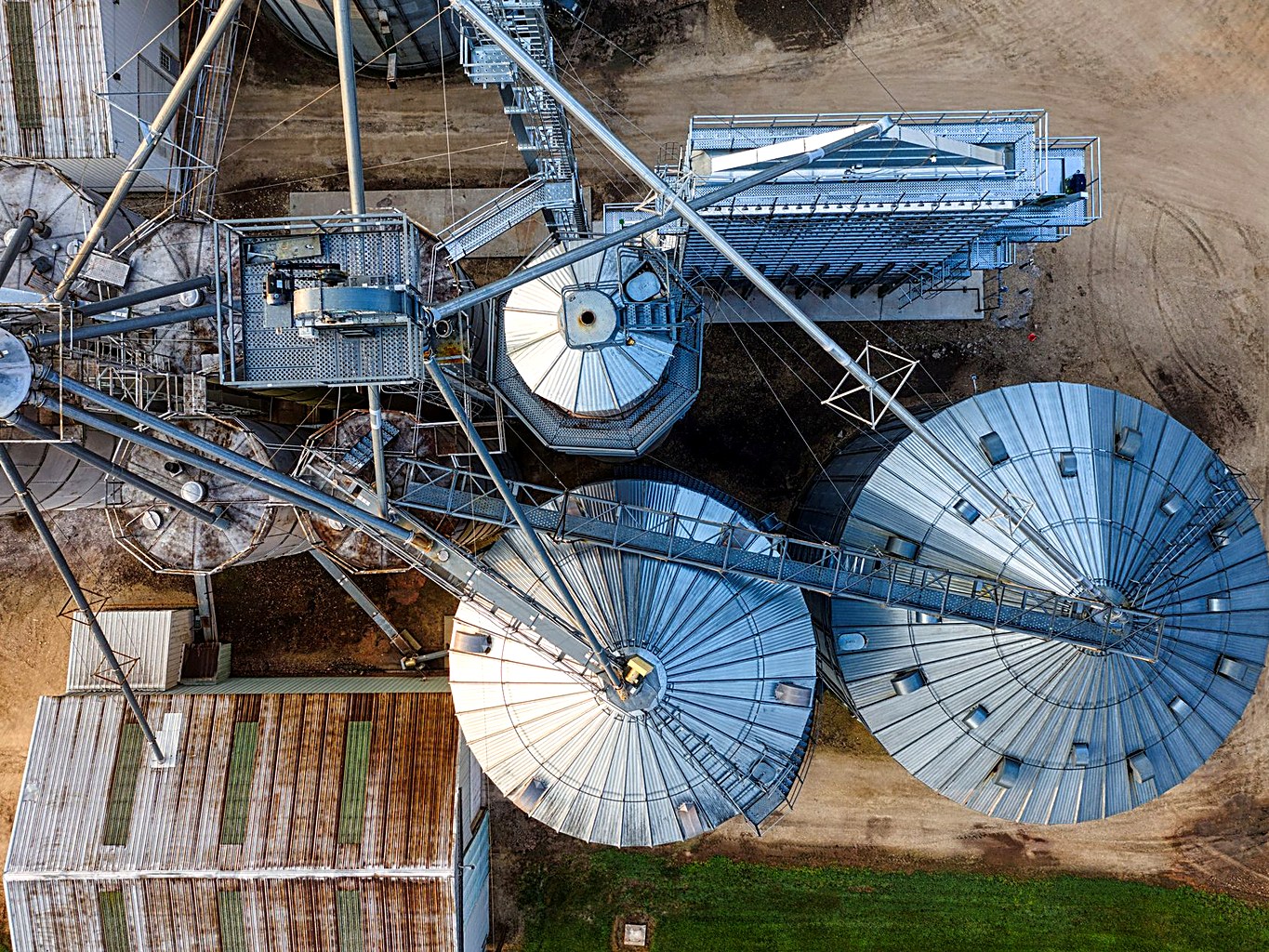
For grain turnover storage, corrugated galvanized bolted silos are the mainstream choice: factory-prefabricated panels bolt together quickly, the galvanized coating handles weather exposure, and capacities from a few hundred tons up to very large farm and depot sizes are all proven. For corn projects specifically, three configuration decisions matter most.
1. Flat bottom or hopper bottom: follow the discharge frequency. Flat-bottom silos with sweep augers or under-floor reclaim suit long-term storage emptied a few times a year; hopper-bottom silos empty fully by gravity and suit high-turnover duty, feed mills and wet-holding ahead of a dryer.
2. Size the geometry around the grain: corn’s natural angle of repose — typically in the 30–40° range — shapes both effective capacity calculations and discharge design. Steeper hopper walls than the repose angle keep corn flowing; flatter store floors must plan for the cone the corn naturally forms.
3. Match the construction type to the duty: where higher airtightness or low-temperature storage is required, sealed and insulated configurations move up the cost ladder — from standard bolted silos, to spiral-folded silos (used for grain with external stiffener columns to prevent grain lodging on the walls), to fully welded silos for the most demanding sealed storage. A well-planned corn project buys the airtightness it needs, not more.
Our corn silo product page shows typical configurations for depot and farm-scale corn storage.
What a Turnkey Corn Storage Project Includes
The silo itself is only one component of a working corn storage system. A complete turnkey scope integrates the full chain: grain receiving pits and elevators, pre-cleaning to remove fines and impurities, drying and cooling, silo filling and distribution conveyors, the aeration and temperature-monitoring systems inside each silo, fumigation-ready sealing where required, and dispatch systems for trucks or processing plants.

Delivered as one EPC contract, this chain arrives with a single design logic: the receiving rate matches the dryer, the dryer matches the silo filling rate, and the aeration and monitoring systems are commissioned together as one control scheme. One party is accountable for the performance of the whole system, and after commissioning the plant runs with one year of free maintenance support while the owner’s team settles in.
Storage losses in humid climates are not an act of nature — they are an engineering gap. As commercial corn storage scales up, more operators are replacing flat-store warehouses and ad-hoc setups with purpose-built steel silo systems that integrate aeration, monitoring, cleaning and drying from day one. A recent turnkey project at a port grain terminal combined large flat-bottom bolted silos with full receiving, cleaning, aeration and dispatch systems, and the storage chain has run through successive humid seasons without unplanned stoppage.
For companies planning to build or upgrade corn storage in a humid climate, the fastest way to de-risk the project is to bring the storage, aeration and drying design together under one responsible contractor. See our service page or send us your tonnage, harvest moisture and site conditions — we will come back with a layout and specification proposal.